
Missouri City Criminal History Checks
A useful Missouri City record check starts by separating a police report from a court record. The Missouri City Police Department holds its own incident and arrest narratives. The Missouri City Municipal Court holds citations issued into that court. County clerks hold more serious prosecutions, and the county jail records custody. These sources describe different stages, so a complete self-review may require more than one stop.
Use the record type and location to choose the route:
- Ask the city for an MCPD incident or arrest report through the official public-information process.
- Use the citation or case number to check the Missouri City Municipal Court portal and eligible resolution options.
- For Fort Bend custody, search the Sheriff’s current jail inquiry by first and last name.
- Check the Fort Bend District Clerk for a felony or County Clerk for a Class A or B misdemeanor.
- Use the Texas DPS public name search only for the narrower statewide public conviction and deferred-adjudication history.
When the event happened in the Harris County portion, replace the Fort Bend county steps with the proper Harris County custodian. Do not assume the mailing city proves jurisdiction.
Missouri City’s Two-County Record Trap
Missouri City extends across Fort Bend and Harris counties. That is the key local fact in any Missouri City criminal records search. The municipal court can still identify a city citation, but a county-level charge follows the county where the case was filed. A search in only one county can miss a valid record from the other side of the line.
Before ordering a certified record, find the arrest address, booking county, arresting agency, and cause number. Court papers may also name the clerk and court. If those details are missing, start with MCPD for its report and ask which detention system received the person. Then confirm the filed case with that county’s clerk. A city name is not a substitute for the filing venue.
Missouri City’s July 1, 2024 population estimate was 78,582. Citywide totals therefore span a large community, but they should not be treated as Fort Bend-only totals when official crime data includes both county portions.
Note: Confirm the county before paying for copies because Missouri City records can route to different county courts from the same city.
Records at the Missouri City Police Department
The Missouri City Police Department creates the original city incident and arrest report. Its main number is 281-403-8700. A request should identify the MCPD incident number when known, the date and time, address, involved name, and the exact component sought. Useful descriptions include the basic incident report, arrest narrative, supplement, CAD record, 911 audio, or body-camera footage.
The city’s public-information custodian, rather than the municipal-court clerk, handles police material. Requests for body-camera recordings need enough detail to identify the event, including the specific date and time, location, and at least one known subject as required by Texas Occupations Code §1701.661. Active investigative facts and protected victim, juvenile, medical, or security information may be redacted or withheld.
The official Missouri City Police Department page provides a visual check that the reader has reached the city source rather than a county agency.

The department page is the dependable place to confirm current contacts before submitting a Missouri City police-record request.
Build a Missouri City Police Request
A precise request helps the city locate the right Missouri City record and decide which portions can be released. Ask for a named item instead of all records about a person. Include the incident or report number if available. Add the event date, a narrow time range, the street or block, involved names, and whether the request concerns a report, recording, dispatch entry, or other file.
- Incident report
- The police narrative and basic facts recorded for a reported event, which may exist even without an arrest.
- Arrest report
- The MCPD record of the custody event and asserted offense, not a finding of guilt.
- Booking record
- The detention system’s intake and custody entry, separate from the police narrative.
- Court file
- The pleadings, docket events, orders, and outcome created only after a charge or citation is filed.
If a record concerns a live investigation, the city may rely on Government Code §552.108. Other Texas Public Information Act provisions protect confidential facts, motor-vehicle data, account numbers, and Social Security numbers. A redacted response does not mean the underlying incident never occurred.
Booking and Arrest Records in Missouri City
An MCPD arrest can generate several Missouri City records at once. Police create the offense or arrest report. The receiving detention agency creates a booking record. A magistrate creates warning, probable-cause, and bond entries. If prosecutors file a charge, the appropriate clerk opens a case. For an arrest in the Fort Bend portion that is booked by FBCSO, use the Fort Bend Jail Public Information Inquiry for current custody.
The jail inquiry accepts full or partial first and last names. A result can show a booking or JID identifier, booking date, custody status, charge text, bond information, and holding data. No match means only that the person was not found in the live search at that moment. It does not rule out release, transfer, a spelling variation, a city report, or a booking in Harris County.
For historical arrest material, return to MCPD for the city report. If a Fort Bend prosecution was filed, use the county clerk system. The broader Fort Bend arrest search explains the county booking and records-request routes in depth.
Missouri City Citation Search Fields
The city court says a citation issued by a Missouri City officer was probably filed there. Search with the direct identifier from the citation when possible. Exact spelling matters when a name is used. The online action may show case information and resolution paths for eligible city matters, but it does not turn the result into a broad criminal-history report.
| Search route | Best input | Scope |
|---|---|---|
| Online case view | Citation or case number | Missouri City municipal matter |
| Identity search | Exact defendant name | Possible city-case match |
| Clerk fallback | Known citation facts | City cases only, 281-403-8669 |
If the portal returns no case, check the citation for the issuing court and allow for filing lag. Then call the municipal clerk. A county misdemeanor or felony will not appear merely because the police event happened inside Missouri City.
Note: Online resolution choices address eligible city cases and do not replace the filed disposition or a certified court record.
The Missouri City Municipal Court File
The Missouri City Municipal Court handles city ordinances and fine-only citation matters within its jurisdiction. Its main number is 281-403-8669. The court explicitly says it has no access to county records or another city court’s records. That limit is especially important in a city that crosses a county boundary.
The official Missouri City Municipal Court page shows where city case viewing and eligible resolution services begin.
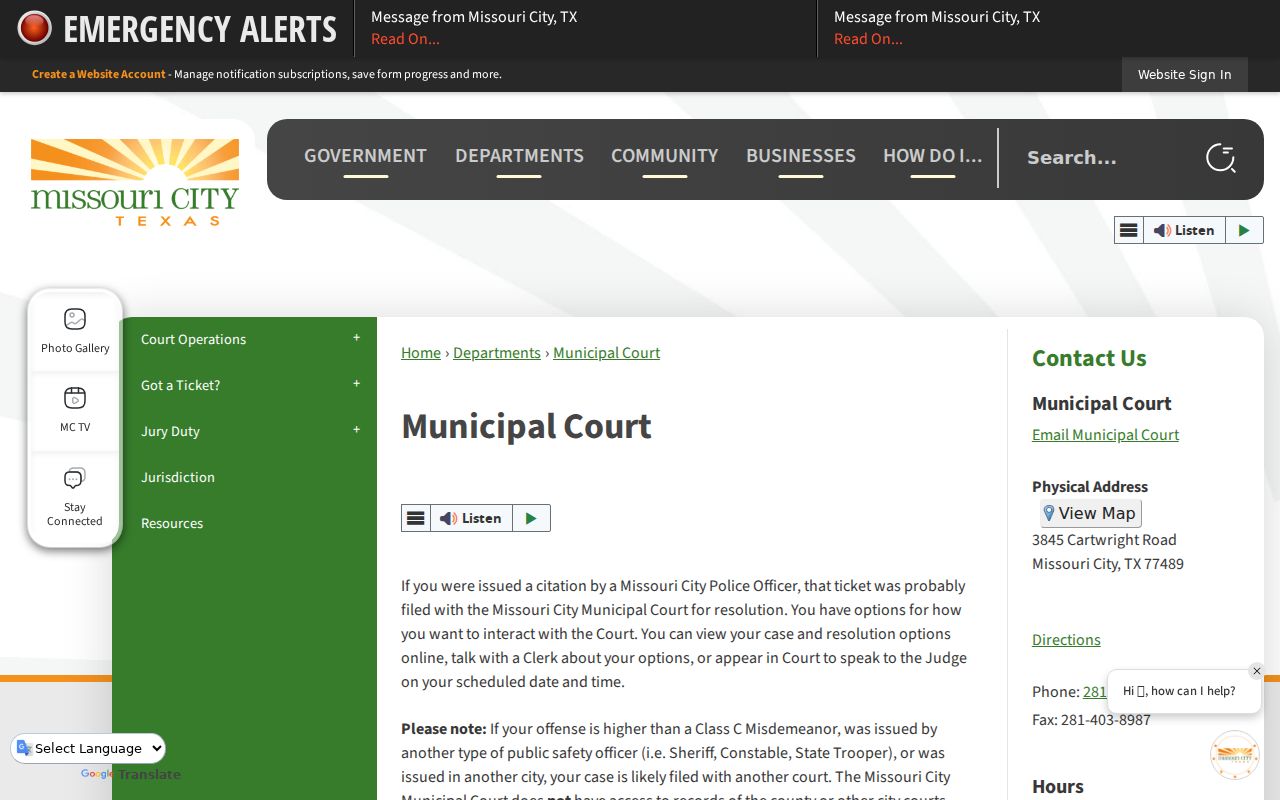
This court channel should be used for the city citation itself, while a Fort Bend Class A or B misdemeanor goes to the County Clerk and a felony goes to the District Clerk.
| Court Name | Missouri City Municipal Court |
|---|---|
| Case Types Heard | City ordinances and fine-only municipal citations |
| Case Lookup Channel | Online case viewing or the clerk at 281-403-8669 |
| What the Docket Shows | City case information and eligible resolution options |
| Copies & Fees | Ask the clerk for the current written procedure and price before ordering |
Missouri City Records by Charge Level
Charge level determines which court keeps the Missouri City case. A fine-only Class C matter or ordinance case generally remains with municipal court. A Class A or B misdemeanor filed in Fort Bend goes to a County Court at Law and the County Clerk. A felony proceeds in District Court and is kept by the District Clerk. The arresting officer’s first charge can differ from what prosecutors later file.
| Record sought | Fort Bend custodian | What it answers |
|---|---|---|
| City citation | Missouri City Municipal Court | City docket, options, and outcome |
| Class A/B misdemeanor | Fort Bend County Clerk | County-court filing and disposition |
| Felony | Fort Bend District Clerk | District-court case and judgment |
| Police narrative | Missouri City public-information custodian | Reported event and investigation |
For the court file, read the case status, events and orders, charge, and disposition together. An arrest entry or pending filing does not prove guilt. The judgment or signed dismissal provides the stronger answer about outcome.
How Missouri City Records Reach the County
When MCPD makes a qualifying arrest, the city report remains with police even after the person enters a county detention system. Prosecutors then decide whether and what to file. The county clerk opens a misdemeanor case, or the district clerk opens a felony case. Fingerprints and arrest-event data for reportable offenses travel to the Texas Department of Public Safety, and the later prosecution outcome should be matched to that arrest cycle.
Record flow: Missouri City Police Department › Fort Bend County Courts › Texas Department of Public Safety
The line changes at the county step when the event belongs in Harris County. It also does not mean every detail moves forward. The city keeps its narrative, the jail keeps custody data, the clerk keeps the filed case, and DPS keeps a statewide repository cycle. Search the source that answers the question, then compare records if dates, names, or charges conflict.
When Missouri City Records Are Missing
A blank city search can have several local causes. The citation may not yet be filed. A name may be spelled differently. The matter may be a Fort Bend county charge rather than a municipal case. It may belong to Harris County, another city court, or another arresting agency. Start with the paper citation or report number instead of repeating a broad name search.
Call the city court only for city citations. Call MCPD for the police narrative. For a Fort Bend filing, select the District Clerk criminal portal for a felony or the County Clerk portal for a Class A or B misdemeanor. The county misdemeanor Register of Actions can show party data, events and orders, and financial information. If no online felony record appears, the District Clerk also offers a manual name search; county-wide details belong in the Fort Bend court case lookup.
Do not treat re:SearchTX as the final answer. Its public document corpus has historically excluded criminal case records, which makes the local clerks the dependable source for Missouri City county charges.
Reading Missouri City Criminal Records
Each Missouri City record has a narrow meaning. An incident report describes what police received and investigated. An arrest record documents custody based on a warrant or probable-cause process. A booking entry shows jail intake and bond or hold data. A municipal docket shows what was filed in city court. None of those facts alone establishes a conviction.
For a final outcome, locate the court disposition or judgment. “Dismissed” ends that prosecution without a conviction but does not by itself erase the city report or arrest cycle. “Deferred adjudication” avoids a final adjudication of guilt after successful completion, yet it may still appear in the DPS public product unless legal relief applies. “Convicted” reflects a judgment of guilt, and “acquitted” means not guilty.
Review dates and identifiers across sources. A report number, booking JID, citation number, and county cause number are not interchangeable. Keeping each key beside its source prevents a record from one Missouri City event from being attached to another person or case.
Note: A name match is only a lead; compare the official identifiers and obtain the signed disposition before drawing a conclusion.
Missouri City Record Access Rules
Missouri City police records are subject to the Texas Public Information Act, but public access is record-specific. Completed public information is generally available unless a law permits or requires withholding. Active-investigation material, confidential victim or juvenile information, motor-vehicle data, account numbers, and Social Security numbers can be removed. Court records follow statutes, court rules, common law, and the court’s supervisory authority rather than the ordinary agency-request process alone.
Key Statutes:
Texas Government Code Chapter 552 gives access to public information while defining exceptions, redaction rules, charges, and review procedures.
Texas Government Code Chapter 411 limits dissemination of DPS criminal-history record information and governs the public subset.
Texas Code of Criminal Procedure Chapter 55A governs expunction of qualifying arrest records after the required order and notice process.
Ask the office that created or filed the record. A denial, redaction, cost estimate, or request for clarification has a different legal meaning from a statement that no responsive record was found.