
Criminal Court Cases in Fort Bend County
Fort Bend County routes criminal cases by offense class. District courts hear felony indictments, and the Fort Bend County District Clerk keeps those case files. County Courts at Law 1 through 6 hear Class A and Class B misdemeanor cases, which are kept by the County Clerk. A Class C or city ordinance citation usually remains with the issuing municipal court. Justice courts keep fine-only matters filed in their own precincts. Picking the wrong clerk can yield a clean search even though a valid case exists elsewhere.
The clerk is the custodian of the filed court record. Police reports and arrest affidavits remain with the agency that made or investigated the arrest. The prosecutor decides which charge to file, so the court charge may differ from the officer's initial description. A complete Fort Bend County court case lookup reads the case number, assigned court, filing date, current status, events, orders, and final judgment together.
The Fort Bend County District Clerk's official page shows the county's felony-record gateway and current clerk services.

That gateway leads searchers to the local criminal index, which is the dependable starting point for a Fort Bend felony case.
Fort Bend Court Jurisdiction Split
The offense label tells a reader where to begin. A felony goes to the District Clerk. A Class A or B misdemeanor goes to the County Clerk. A fine-only Class C charge belongs to a municipal or justice court if it was filed there. Texas punishment classes help explain the split: Class C ordinarily has no jail punishment, while Class B and A misdemeanors may carry county-jail time. State jail and higher felonies proceed in district court.
This division also shapes the search tools. The District Clerk portal asks for a location and supports a case-number or party-name search. The County Clerk misdemeanor system offers case number, party name, attorney, and date-filed modes. Missouri City, Sugar Land, Fulshear, and other city courts cannot search Fort Bend County court-at-law or district records. When the charge class is unclear, start with the charging paper or the arresting agency's cause reference instead of running the same name through one portal again.
Routing line: Felony › District Clerk | Class A/B misdemeanor › County Clerk | Class C or city ordinance › issuing municipal or justice court.
Fort Bend County Case Record Searches
The Fort Bend County Online Services directory links the felony and misdemeanor systems. Use an exact case number when one appears on a notice, bond paper, or charging document. Name searches are useful, but spelling variants and shared names can create missed or false matches. Read the Register of Actions after opening a result. A result row alone does not establish the outcome.
- Classify the matter as a felony, Class A/B misdemeanor, or fine-only city or justice-court case.
- Open the matching Fort Bend County clerk portal and select the criminal location or search mode.
- Enter the exact case number when known. Otherwise search the party name and narrow with fields the official interface allows.
- Open the linked case number and review the status, parties, Events and Orders of the Court, and financial section together.
- Order the judgment, dismissal, or other controlling document when a plain docket entry is not enough.
- Ask the proper clerk for a manual search when an older or expected case does not appear online.
| Portal and field | Type | When used | Search note |
|---|---|---|---|
| District location | Dropdown | Required | Select Fort Bend County - District Clerk - Criminal |
| District case number | Text | Conditional | Use the exact format shown on case papers |
| District party name | Text | Conditional | Last or business name; first name can narrow results |
| County Clerk search mode | Tabs/options | Required | Case Number, Party Name, Attorney, or Date Filed |
| County Clerk case link | Result link | After search | Opens the misdemeanor Register of Actions |
For deeper context about the arrest that came before a filing, use the separate Fort Bend County arrest search. Court records remain the source for the filed charge and disposition.
Missing Fort Bend Felony Cases
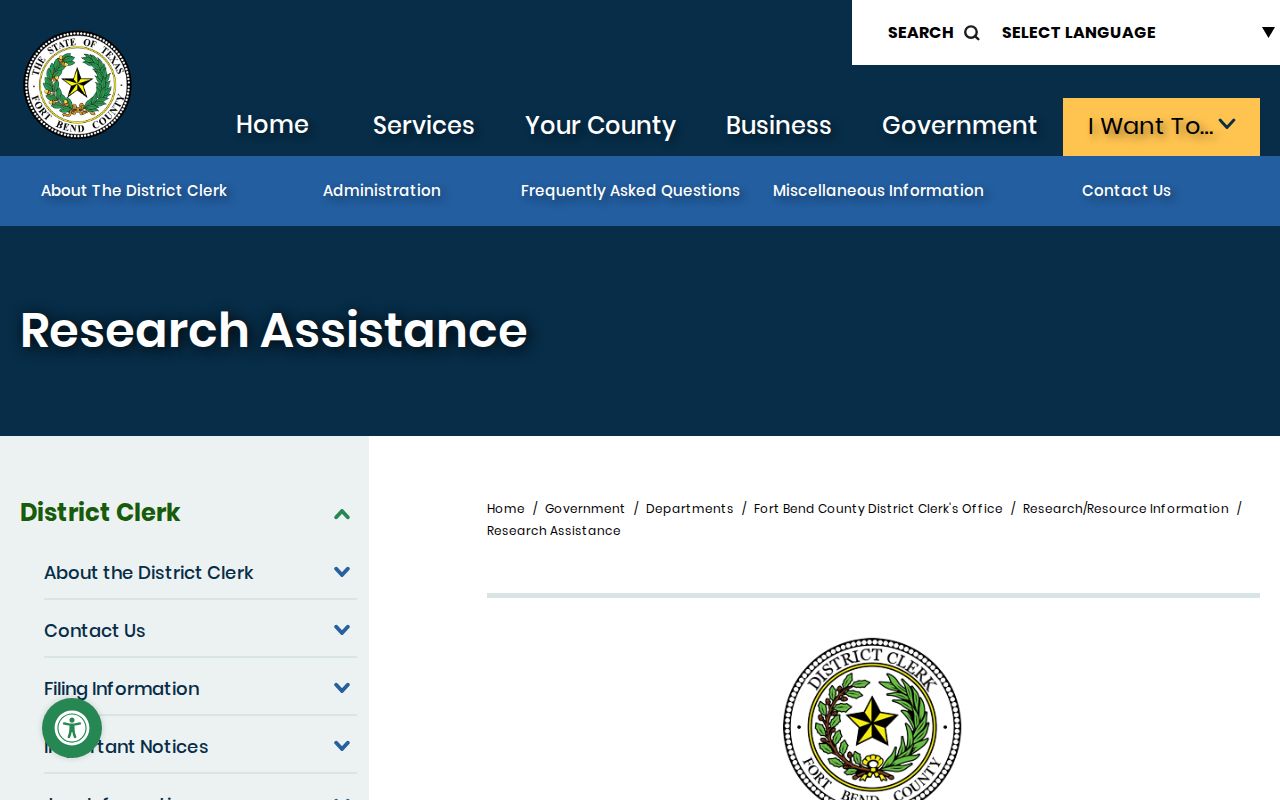
A blank portal result does not always mean no Fort Bend County criminal case exists. The District Clerk offers research assistance and a written staff search for $5 per name. The ordinary search covers ten years unless the requester asks for a different span, and the published processing time is three business days. The request form states that felony coverage extends from 1982 to the present. An older file or an expected pre-1982 matter needs a specific year-range request.
The form asks for the name searched and can accept identifying details, plus the requester name, mailing information, telephone, and payment transaction data. Submit sensitive data only through the clerk's secure official route. Telephone copy requests are not accepted. Name variants, old spellings, and a changed filed charge can also explain why a web search fails.
The District Clerk research-assistance page sets out the staff-search route and current copy options.
This fallback matters most when a portal index is incomplete, the case is old, or the exact case number is unknown.
What a Criminal Case File Contains
A Fort Bend County case file begins when a complaint, information, or indictment is filed. The Register of Actions is the chronological index, not a substitute for each underlying paper. It may show an arraignment, reset, motion, hearing, plea, dismissal, judgment, sentence, community supervision, capias, or bond-forfeiture event. The final signed judgment or dismissal order carries more weight than a short status label.
| Case number and court | Identifies the Fort Bend case and the district or county court assigned to it. |
|---|---|
| Charging document | Shows the offense prosecutors filed, which may differ from the arrest charge. |
| Parties and attorneys | Lists the defendant, counsel, and other public case participants. |
| Events and orders | Tracks settings, motions, pleas, resets, warrants, and signed court action. |
| Financial information | May list assessed fines, costs, payments, or balances tied to the case. |
| Disposition and sentence | States dismissal, acquittal, deferred adjudication, conviction, and any sentence or supervision shown. |
Public views can omit sealed filings, protected juvenile material, victim data, Social Security numbers, and full financial-account details. A filing or pending status does not prove guilt.
Read Fort Bend Case Dispositions
Disposition terms answer different questions. “Dismissed” ends that prosecution without a conviction, but it does not by itself erase the arrest record. “Deferred adjudication” means the judge deferred a final finding of guilt while the person completed court-ordered conditions. It may still appear in the DPS public criminal-history product unless legal relief applies. “Convicted” reflects a judgment of guilt. “Acquitted” means a not-guilty result.
- Arraignment
- The stage when the accused is told the charge and enters or addresses a plea.
- Reset
- A docket entry moving a setting to another date; it is not a disposition.
- Capias
- Court process directing custody in connection with an existing case.
- Deferred adjudication
- Supervision without a final adjudication of guilt, subject to completion and Texas reporting rules.
- Judgment
- The signed court document stating the result and any sentence.
Always compare the charge on the judgment with the original arrest wording. A charge can be reduced, enhanced, rejected, or replaced before the Fort Bend County court case ends.
Criminal Case Stages in Fort Bend County
The court file follows prosecution, not just custody. After an arrest and prompt magistrate review, prosecutors may file a misdemeanor information or seek a felony indictment. Arraignment comes next, followed by discovery, motions, and pretrial settings. The case can end through dismissal, plea, or trial. If there is a conviction, the judgment and sentence state the legal result. An appeal creates a later layer of court records.
Case flow: Charges Filed › Arraignment › Pretrial › Plea or Trial › Disposition › Sentencing.
Fort Bend County Court at Law 5 publishes a local process that includes in-person misdemeanor resets, Friday arraignments, and some jail arraignments in the jail courtroom. Court 6 warns that failure to appear on a court-cost reset may lead to a failure-to-appear warrant. These docket entries can affect what a person must do next, even before the case has a final outcome.
Fort Bend Cases and re:SearchTX
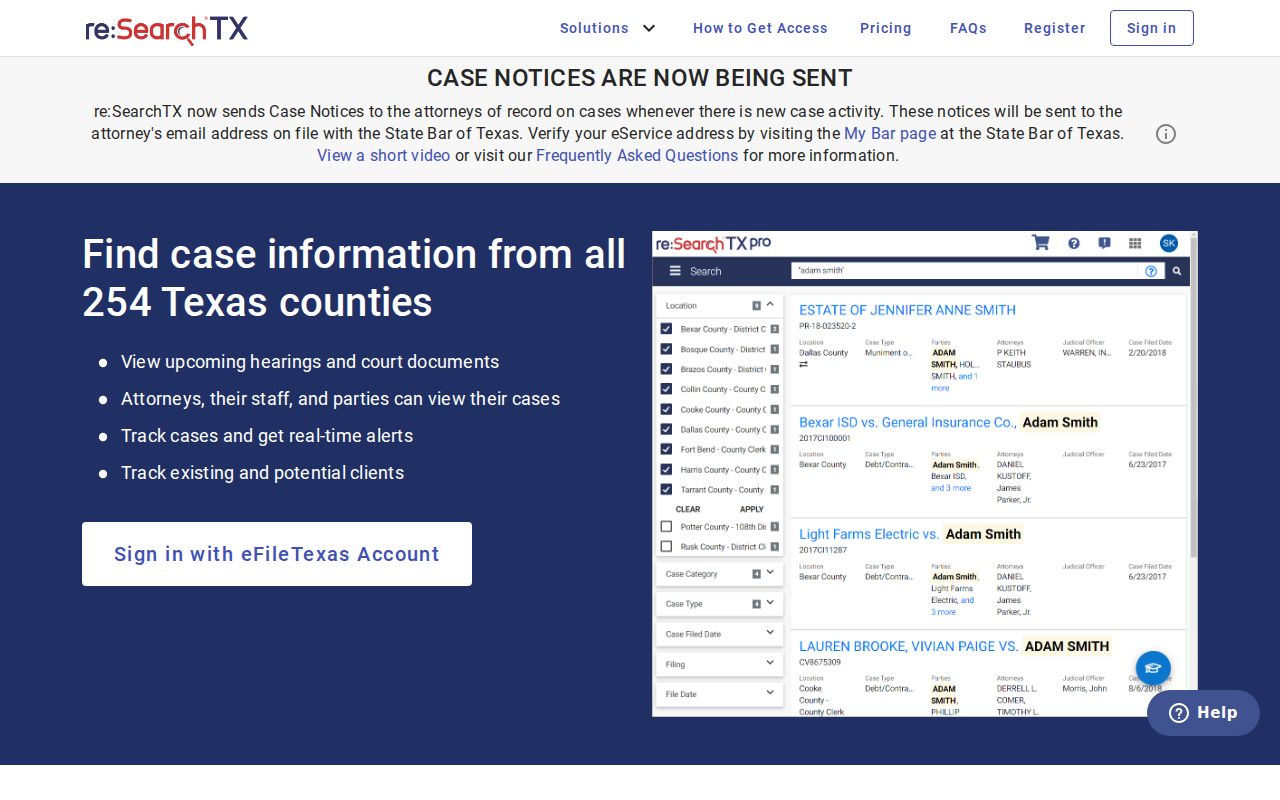
re:SearchTX is the named statewide electronic court portal, but it should not replace the local Fort Bend criminal indexes. Official Texas reporting has noted that its public document corpus historically excluded criminal case records. Registration is required, and document access may carry charges. A no-result response there does not prove that a Fort Bend County court case is absent.
The local District Clerk and County Clerk systems remain the sound first choice for filed Fort Bend criminal cases.
Use re:SearchTX only as a supplementary state layer. When the local portal is unavailable, contact the correct clerk rather than waiting for the statewide system to fill a gap.
Certified Fort Bend Court Records
Online docket text can answer a quick status question, but a certified judgment or order is the stronger record when official proof is needed. District Clerk electronic noncertified copies cost $1 for the first ten pages and $0.10 for each added page per document. Electronic certification adds $5. Paper plain copies are $1 per page, and certification adds $5 per document. The County Clerk lists a similar electronic schedule and charges $5 certification plus $1 per page for certified copies.
The District Clerk announced E-Certify in June 2026, with previews of up to 50 pages and same-day certified delivery for eligible material. Restricted case types stay restricted. The Justice Center filing drop box ended in July 2026, so filings now go through the counter or eFileTexas. Verify the live fee page before ordering because service terms can change.
Ask for the specific judgment, dismissal, or signed order instead of buying every docket item. That keeps the request focused and reduces copy cost.
Access Rules for Case Records
Texas court case files do not operate exactly like ordinary agency records under the Texas Public Information Act. Court records are governed by statutes, court rules, common law, and each court's supervisory power. Judicial administrative records use Texas Rules of Judicial Administration Rule 12. The clerk can explain the access procedure, but cannot release material that law or a court order seals.
Government Code Chapter 411 separately limits criminal-history record information held by DPS. That statewide repository is not the Fort Bend case file. Juvenile records have special confidentiality rules, and public clerk views can redact victim identifiers, motor-vehicle data, Social Security numbers, access-device numbers, and sealed papers. A restricted item may still leave a public docket entry showing that action occurred.
The Fort Bend County Justice Center and District Clerk are at 1422 Eugene Heimann Circle, Richmond, Texas 77469. The District Clerk is open weekdays from 8:00 a.m. to 5:00 p.m. and can be reached at 281-341-4515. The County Clerk can be reached at 281-341-8685 for county-court misdemeanor files.