
Fort Bend County Criminal History Checks
Choose the record stream before entering a name. Current custody belongs in the Fort Bend County Jail Public Information Inquiry. A felony filing belongs in the District Clerk criminal portal, while a Class A or B misdemeanor belongs in the County Clerk search. City citations stay with the issuing municipal court. The Texas DPS Criminal History Conviction Search supplies a narrower statewide public result for convictions and deferred adjudications that Texas may release.
Gather the full name, spelling variants, date of birth when the form permits it, and any case, citation, incident, or booking number. Compare identity details, then open the source that shows the event and its outcome. For a personal statewide review, use fingerprints rather than treating a public name match as conclusive.
Common search failures come from using only one system. The jail does not answer whether an old case was dismissed. DPS may omit a dismissal from its public product, and re:SearchTX is not the best first stop for local criminal cases. If a clerk portal misses a likely file, try the other county clerk, check name variants, and request a manual year search. For an agency narrative, return to the police department that wrote it. A Fort Bend County criminal case search works best when each result is verified against its source.
- Decide whether the event is custody, an agency report, a filed case, or statewide history.
- Search the matching official system with the most exact identifier available.
- Compare names and dates carefully, especially for common names.
- Trace an arrest into the clerk docket to find the filed charge and disposition.
- Order a certified copy or fingerprint record when official proof is needed.
Two Fort Bend Criminal Record Counters
Fort Bend County separates police records from felony court files. The Sheriff Records Lobby is at 1410 Richmond Parkway in Richmond. It accepts written requests on weekdays from 8:00 a.m. to 4:00 p.m. and can provide Sheriff offense reports, accident reports, arrest affidavits, and local criminal-history checks when releasable. The jail counter does not give out those reports.
The District Clerk felony counter is at the Fort Bend County Justice Center, 1422 Eugene Heimann Circle, Richmond. Public hours are weekdays from 8:00 a.m. to 5:00 p.m. County Clerk staff handle Class A and B misdemeanor files separately. That physical split explains why one desk cannot provide every Fort Bend criminal record.
The historic courthouse at 401 Jackson Street is an important Richmond landmark, but it is not the operational felony-record counter. Visitors to the justice campus should allow time for security screening and bring government identification when a service requires identity review. A judge can restrict phones, photography, or recording in a courtroom. Ask the particular court in advance about an interpreter or ADA accommodation rather than assuming that one central county desk handles those arrangements.
FBCSO Records Division
1410 Richmond Parkway, Richmond, TX 77469
281-341-4625
Weekdays, 8:00 a.m.-4:00 p.m.
District Clerk
1422 Eugene Heimann Circle, Richmond, TX 77469
281-341-4515
Weekdays, 8:00 a.m.-5:00 p.m.
Use the first office for Sheriff-created reports and the second for the filed felony case.
Official Background Checks in Texas
The Texas Department of Public Safety Crime Records Division is the central criminal-history repository. Its public name portal requires an account and search credits. It returns the public conviction and deferred-adjudication subset, not a fingerprint-confirmed full history. Similar names and birth dates can produce a possible match, so confirm any candidate with the Fort Bend clerk record.
A person reviewing their own Texas record should follow the DPS TXIReview fingerprint process and schedule through IdentoGO by IDEMIA. The live scheduler supplies current Fort Bend-area sites, hours, identification rules, and vendor cost. The official page below shows that record-review route.
The FBI offers a separate Identity History Summary for the subject of the record. Its electronic request uses fingerprints and carries a base FBI fee of $18, while approved channelers may add their own fees. That federal summary is not a substitute for a Fort Bend court search. If a Texas record looks incomplete, DPS directs the subject to obtain the fingerprint report, identify the arrest cycle, and provide certified court disposition material when needed.
FAST is the Texas fingerprint capture program used for the personal review route, and IdentoGO by IDEMIA operates the appointment channel. The scheduler, not a static directory, is the reliable source for a nearby site and current charge. Bring identification accepted for the selected service and use the TXIReview service code supplied by DPS. A name search and a fingerprint review serve different purposes, so the cheaper public result should not be described as a complete personal rap sheet.
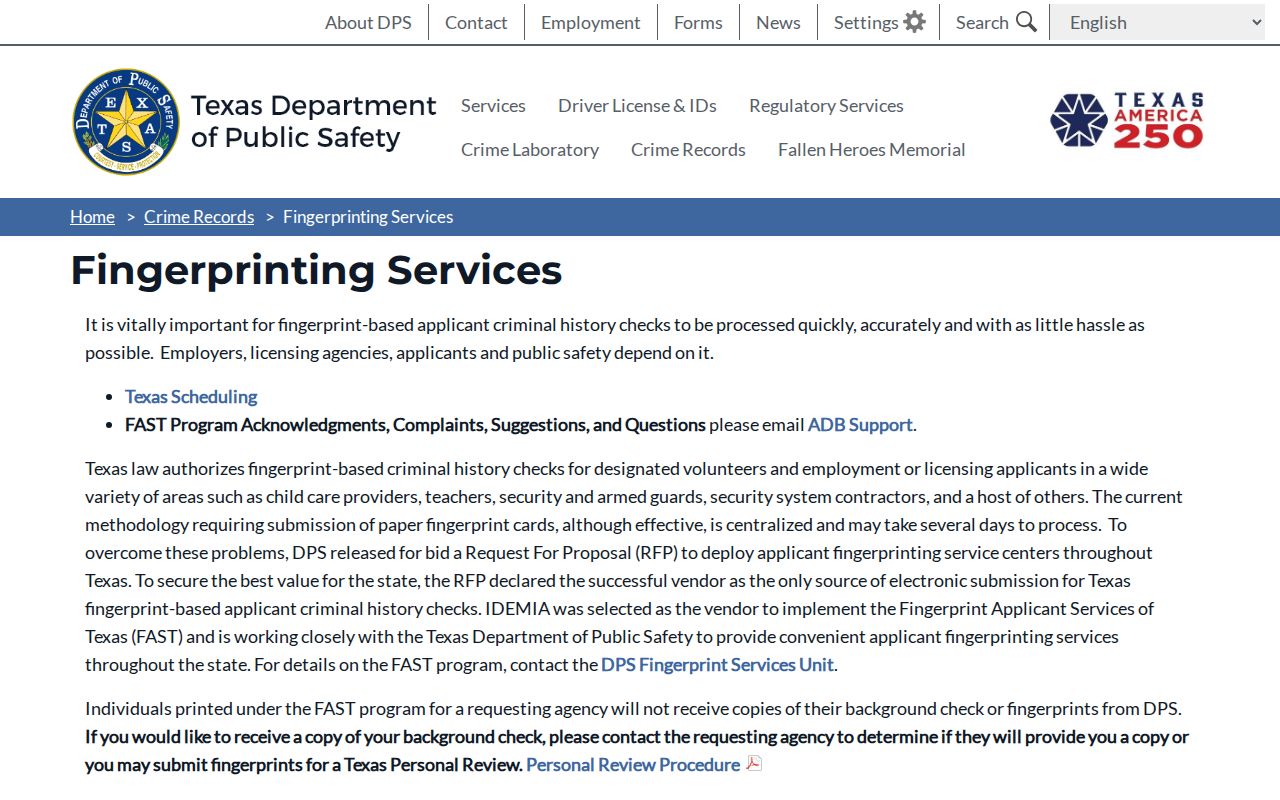
Fingerprint comparison is the reliable way to distinguish a subject's own record from a name-only candidate.
Request Fort Bend Sheriff Records
The Sheriff Records Division is the fallback when no public database shows the needed narrative. Requests must be written. Send one through FBCSO Public Information, by email at fbcsorecords@fortbendcountytx.gov, by fax at 832-471-2472, by mail, at the Records Lobby, or through the official FBCSO mobile app. Describe the record, date range, names, address, incident number, and exact item sought.
The division asks requesters to allow 10 business days for a response, while complex or large requests can take longer. A request received after 4:00 p.m. starts on the next business day. Charges can cover copies or redaction and should be disclosed in advance. The official app also groups Jail Inquiry, alerts, contacts, and the records route in one mobile menu.
The posted request form asks for requester contact details, a preferred response method, a clear description, and a signature. Dates, times, addresses, names, and incident numbers help staff isolate the correct report. The form does not publish one flat fee or require notarization on its face. Released material may contain Attorney General-compliant redactions. Government Code sections 552.101, 552.108, 552.117, 552.130, 552.136, and 552.147 are among the authorities that can protect confidential or sensitive information.
Agency ownership matters beyond FBCSO. Sugar Land, Missouri City, Fulshear, Rosenberg, Richmond, Stafford, constables, school police, and Texas DPS each keep the reports their officers create. A city arrest can appear in the county jail while the police narrative remains at the city. Crash records may follow TxDOT CRIS instead of the arresting department's ordinary report route. Start with the agency name shown on the booking or citation, then ask that custodian for the basic report, supplement, CAD entry, audio, video, or crash record actually needed.
See the Fort Bend County gateway used to reach county offices and services.

The gateway is a directory, so the final request still belongs with the office that created the record.
Kinds of Criminal Records
One Fort Bend incident may create several records. Police write the first report. The jail records intake and custody. A magistrate records warnings and bond decisions. Prosecutors decide what to file, and the proper clerk maintains the court case. Fingerprints from qualifying arrests flow toward DPS, where a later disposition should be matched to the arrest cycle.
These sources can differ for a valid reason. The officer's initial charge may be rejected, reduced, enhanced, or replaced. A booking entry can remain after release, while a clerk docket later records dismissal or conviction. Read each source for the job it performs.
- Incident report: the agency narrative, location, witnesses, and investigative material.
- Booking record: jail intake, charge, bond, custody, and release information.
- Court case: filed charge, motions, orders, disposition, sentence, and costs.
- DPS cycle: a fingerprinted arrest linked to prosecution and disposition reports.
- Supervision or registry record: a separate public view with its own access limits.
Some terms describe process, not guilt. A warrant authorizes an arrest or commands action in a case. A capias is court process that can follow a missed appearance or other event. Deferred adjudication postpones a finding of guilt while the person completes court-ordered terms. Community supervision is the Texas term commonly used for probation. Each label should be read with the connected court order.
Texas offense levels also control where a filed case appears. Municipal courts generally handle Class C and fine-only city matters. Fort Bend County Courts at Law hear Class A and B misdemeanors, while District Courts hear felonies. A Class C label normally carries no jail as the ordinary punishment. Class B and A misdemeanors can carry county-jail exposure. State-jail, third-degree, second-degree, first-degree, and capital felonies use separate punishment ranges, and enhancements can change the range. The intake label alone does not predict the final filed level.
Arrest and registry records need special care. The official Fort Bend arrest search routes separate current jail custody from an agency report and the later filed case. The Fort Bend sex offender lookup uses the Texas DPS registry for regulatory public-safety information, not a general criminal-history report. Registry profiles can show identification, photograph, address, reportable offense, registration status, and risk data when public, while Texas law keeps victim identity and other protected fields out of the result. Use registry information for personal and family safety, verify it with the local registration authority, and never use it to threaten, harass, trespass, or confront a listed person.
- Disposition
- The recorded outcome of a charge, such as dismissal, plea, trial result, or deferred adjudication.
- Register of Actions
- The clerk's dated sequence of parties, filings, hearings, orders, and financial entries.
- Capias
- Court-issued process directing an arrest in connection with a case.
- Arrest cycle
- The DPS grouping that links one fingerprinted arrest to later prosecution and disposition reports.
Fort Bend Jail and Booking Records
The Sheriff Jail Public Information Inquiry accepts full or partial first and last names. Results may show the inmate name, JID or booking identifier, booking date, custody status, charges, a case or warrant reference, bond amount and type, and holding details. A missing result means the person is not currently found in that live interface. It does not prove that no arrest happened.
For a state-prison transfer, switch to the TDCJ Inmate Search. Use the federal Bureau of Prisons locator for federal custody. Historical Sheriff booking material that no longer appears online requires a written records request. The Bonding Office at 281-341-4619 can explain processing, but a displayed bond does not guarantee immediate release when another hold or order remains.
Booking normally moves through identity intake, property inventory, health screening, a photograph, fingerprint capture, charge and hold entry, classification, and magistration. Texas law requires magistrate warnings without unnecessary delay, generally within 48 hours after arrest. The magistrate addresses the accusation, rights, and bond. The court, not the Sheriff, sets release conditions. Bonding staff must also review commitments, judgments, transfers, dismissal orders, and holds from other courts before a release is complete.
Remote Securus “From-Home” visits resumed on January 16, 2025. The Sheriff lists daily availability from 8:00 a.m. to 9:00 p.m., a $6 visit price, and scheduling at least 24 hours ahead. Those details can change, so confirm them in the live scheduler. The FBCSO app provides current custody navigation and notices, while the website remains the official public inquiry path.
Note: Current custody, the arresting agency's report, and the final court disposition are three different Fort Bend County criminal records.
Fort Bend County Criminal Records: What They Contain
A Fort Bend court file is arranged around a case, while the DPS repository is arranged around identity and arrest cycles. The court's Register of Actions is often best for finding what prosecutors filed and how the case ended. It can show parties, attorneys, events, orders, and financial information. The statewide record adds identifiers and agency reporting fields.
Public views remove protected data. Do not expect Social Security numbers, full financial account details, confidential victim information, protected juvenile files, sealed documents, or sensitive jail classification and medical data.
Docket events can include a complaint or indictment, arraignment, reset, motion, hearing, plea, judgment, sentence, community supervision, dismissal, capias, and bond-forfeiture action. The event list supplies context that a short result row cannot. Financial entries may show assessed costs, but they do not replace the signed judgment. Likewise, the booking charge reflects intake. The filed charge and later disposition may be different, which is why the clerk record should follow any Fort Bend arrest review.
| Name and identifiers | Submitted name, aliases, date of birth, state ID, FBI number, or transaction identifiers when releasable. |
|---|---|
| Arrest and booking | Arrest date, agency, tracking or JID number, intake charge, bond, and custody status. |
| Charges and statutes | Offense text, level, statute, filed count, and later amendment when entered. |
| Disposition | Dismissal, plea, trial result, deferred adjudication, or other final action. |
| Sentence | Confinement, fine, community supervision, or other terms shown in the judgment. |
| Case activity | Arraignment, resets, motions, hearings, orders, capias activity, and costs. |
Fort Bend Criminal Case Search Fields
Felony researchers should choose “Fort Bend County - District Clerk - Criminal.” The portal searches by case number or party name. Enter a case number exactly as it appears on court papers. The County Clerk misdemeanor search adds attorney and filing-date methods, then opens a blue case number into the Register of Actions.
When the web result is missing, the District Clerk offers a $5-per-name staff search. It normally covers ten years and has a stated three-business-day processing time. The form identifies felony coverage from 1982 forward and lets a requester ask about earlier years.
re:SearchTX supplies a statewide court layer, but public criminal access there was not reliable enough to replace Fort Bend's local portals. Start locally, then use the statewide system as a supplement. The District Clerk announced E-Certify for June 22, 2026, with document previews up to 50 pages and same-day delivery of eligible certified copies. Restricted case types remain restricted. The office also ended its Justice Center filing drop box on July 1, 2026, directing filings to the counter or eFileTexas.
| Fort Bend search | Best input | What opens |
|---|---|---|
| District Clerk criminal | Exact case number or party name | Felony case index and docket |
| County Clerk case search | Case, party, attorney, or date filed | Misdemeanor Register of Actions |
| Manual staff search | Name and requested year range | Clerk research response |
Full records and certified copies carry separate charges even when the index is free.
Texas Public Access Laws
The Texas Public Information Act begins with access to government records, but it does not make every line public. Fort Bend offices may redact confidential identifiers, victim and juvenile information, privileged material, and data tied to an active investigation. Court records also follow judicial access rules. Ask the custodian to identify the authority for withheld material and to release the remainder when possible.
Criminal-history dissemination has separate limits. Texas Government Code Chapter 411 controls DPS criminal-history information. Code of Criminal Procedure Chapter 62 governs the public sex offender registry. A public jail or court result should never be used to infer facts that the record does not state.
Body-camera requests have an added specificity rule under Texas Occupations Code section 1701.661. A requester should identify the date and approximate time, location, and at least one known subject. Police reports can also lose victim, juvenile, medical, security, and active-investigation details through redaction. When an office withholds part of a record, a narrow request for the basic incident report or a particular public section can be more effective than asking for every related file at once.
The Texas Attorney General ruling process applies when a governmental body believes an exception requires a decision. Government Code sections 552.301 through 552.306 set statutory business-day steps for that process. Those deadlines are not a guarantee that a large Fort Bend request will be produced in ten days. Ask for an itemized estimate when charges may be substantial, and narrow the date range, address, incident number, and document type. A focused request gives the custodian a clearer path to separate public material from protected parts.
Key Statutes:
Government Code Chapter 552 provides the Texas Public Information Act request and exception framework.
Government Code Chapter 411 controls DPS criminal-history collection and release.
Code of Criminal Procedure Chapter 55A governs expunction for eligible records.
Code of Criminal Procedure Chapter 62 governs registration and public registry data.
Fort Bend Criminal Record Copy Fees
Search results are not the same as documents. The District Clerk lists electronic noncertified copies at $1 for the first ten pages of each document, then $0.10 per added page. Electronic certification adds $5. Plain paper copies are $1 per page, and certification adds $5 per document. The County Clerk schedule follows similar electronic and paper pricing.
No telephone copy orders are accepted by the District Clerk. Use the clerk's current research and copy process, and ask for an estimate on a large request. Certified material is useful when correcting a DPS arrest cycle because it shows the court's actual disposition.
The District Clerk staff-search form asks for the name, the desired span of years, and requester contact details. Its standard search covers ten years unless the requester gives other instructions. Sensitive fields on an official form should be sent only through the clerk's secure method. Before buying a long file, use the free index to identify the cause number and the specific judgment, order, or docket entry needed.
| District Clerk item | Published charge |
|---|---|
| Staff name search | $5 per name |
| Electronic noncertified document | $1 first ten pages, then $0.10 per page |
| Electronic certification | $5 added |
| Paper plain copy | $1 per page |
| Paper certification | $5 per document added |
Restricted, Sealed & Expunged Records
Texas uses expunction for eligible records under Code of Criminal Procedure Chapter 55A. An expunction order directs named agencies to clear qualifying records. Eligibility is technical and depends on the charge, disposition, waiting period, and other facts. A dismissal by itself does not erase the arrest report, booking event, or DPS cycle.
An order of nondisclosure is different. It limits public disclosure of eligible criminal-history information but permits access by agencies and entities named in Government Code Chapter 411. Juvenile files, victims' identifying details, active investigative material, and sealed court papers also have distinct protection rules. If an expected result disappears, confirm status with the clerk instead of assuming the file never existed.
A record correction and a record restriction solve different problems. Correction addresses wrong or incomplete data in an arrest cycle. Expunction or nondisclosure depends on legal eligibility and a court order. Fort Bend certified dispositions can support a DPS correction, but the clerk cannot change an independent repository by phone. A person should obtain their own fingerprint record, identify the exact event, and follow the official challenge or court process that matches the issue.
Fort Bend Warrant Record Routes
No complete public FBCSO active-warrant name database was verified. Check the court that could have issued the process. District and county Registers of Actions can show felony or Class A and B capias activity. A municipal citation warrant stays with that city court, and a justice-court warrant stays with the proper precinct.
For a Sheriff record, submit a written request or call Records at 281-341-4625. Crime Stoppers takes anonymous tips at 281-342-TIPS, but that line does not verify warrants. A person resolving their own possible warrant should confirm the cause number, issuing court, bond or appearance terms, and whether any recall has reached law-enforcement systems. Do not walk into the jail based only on an unverified web result.
Texas distinguishes an arrest warrant based on a complaint, bench or capias process arising within a case, and capias pro fine tied to a final fine-only judgment. An unexecuted warrant or sealed indictment may not be public. After execution, Code of Criminal Procedure article 15.26 generally makes the warrant and affidavit public, subject to other law. Because court and law-enforcement updates can lag, obtain confirmation from the issuing court before treating an online status as current.
How Fort Bend Arrest Records Reach DPS
Fort Bend booking starts an identity and custody record. Fingerprints for a qualifying arrest move toward DPS with an arrest tracking number and charge data. Prosecutor and clerk updates should later attach the charging decision and disposition to that cycle. A delay between systems can leave a statewide record incomplete even when the Fort Bend docket is current.
For an error in a personal record, obtain the fingerprint-based TXIReview result, identify the exact arrest cycle, and collect certified Fort Bend disposition papers. DPS separates ordinary data correction from identity misuse. It also warns that it cannot force independent third-party sites to update their copies.
That reporting chain also explains timing conflicts. The arresting agency can send fingerprints before prosecutors decide what charge to file. A clerk may post a dismissal or judgment before the matching update appears in the repository. Compare the arrest date, agency, tracking number, case number, and disposition date rather than relying on the charge text alone. The public DPS portal shows only the subset Texas permits it to release.
The DPS public criminal-history portal displays the statewide name-search entry point.
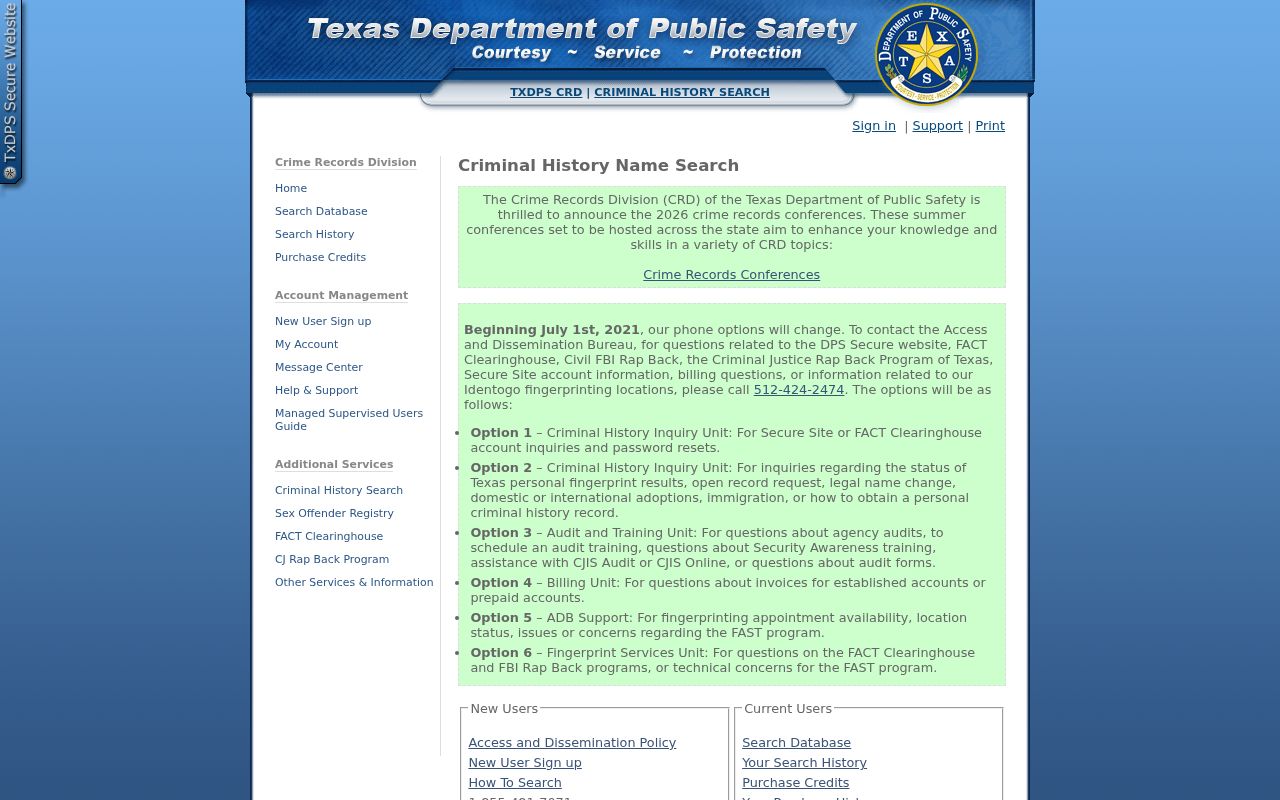
The image represents the public subset, not the complete fingerprint-based record available to the subject.
Fort Bend Supervision Record Boundaries
Fort Bend County Community Supervision and Corrections Department supervises local felony and misdemeanor community supervision, deferred-adjudication matters, specialty caseloads, and pretrial services. Start with the court judgment or Register of Actions to confirm the sentence. Detailed supervision files and officer safety information are not a public online roster.
The Sugar Land CSCD office is at 12919 Dairy Ashford and can be reached at 281-633-7200. TDCJ handles parole field supervision after prison release and may show parole information in its inmate search. Fort Bend also operates the Special Sanctions Court at 117 Legion Drive in Richmond as a named intervention setting. A violation may lead to a motion, capias, hearing, modified conditions, or revocation, all of which must be read in the linked court file.
Fort Bend CSCD also has listings for Beechnut, Fresno, and Missouri City locations. It supervises deferred-adjudication cases and specialized caseloads under local courts. TDCJ parole is a different system and follows state-prison release. VINELink can provide participating custody notifications, but it does not certify a sentence or court outcome. Start with the judgment, then contact the agency responsible for the type of supervision shown there.
Fort Bend Charges and Court Records
The District Attorney reviews law-enforcement submissions and prosecutes felony matters. That office is not the custodian of the clerk's filed case or the police report. The agency keeps its narrative, and the appropriate clerk keeps the public court file. Victims can use the DA Victim/Witness channel, while people seeking appointed counsel follow the court's indigent-defense process.
The official Fort Bend District Attorney page also publishes a 2025 Crime Report. Raw arrest and filing counts need context, including population, offense definitions, agency coverage, and backlog changes. A count does not equal the number of unique guilty people.
Fort Bend uses an indigent-defense and administrative court system rather than one traditional elected public-defender office for every case. An unrepresented defendant may complete a financial-status affidavit and interview for appointed-counsel eligibility. That is a legal-service route, not a public record search. The DA's named programs, including Victim/Witness services and the Anti-Trafficking Collective, likewise serve case participants but do not replace the clerk as record custodian.

The DA page helps explain charging services, while certified outcomes still come from the clerk.
City-by-City Criminal Records in Fort Bend County
City police departments create their own incident and arrest reports, and municipal courts keep their own fine-only cases. Sugar Land, Missouri City, and Fulshear therefore require city-specific starting points even when a person is later booked into the Fort Bend County Jail. A city name alone can misroute a search, especially in Missouri City, which crosses into Harris County, or near Fulshear's fast-changing boundary.
Use each city guide for its police request channel and municipal court. Then move to the Fort Bend District Clerk for a felony, the County Clerk for a Class A or B misdemeanor, or the Sheriff inquiry for a county booking.
Sugar Land has its own police open-records portal and a municipal court at 1200 Highway 6. Missouri City warns that its municipal court cannot see county or other-city cases, and part of the city lies in Harris County. Fulshear routes police reports through the City Secretary and has no separate public city jail roster identified in the research. Its rapid growth makes the arresting agency and current city limits more reliable clues than a mailing address alone.
The 2024 population sources rank Sugar Land first, followed by Missouri City and Fulshear. Those figures describe whole cities, not only the part within Fort Bend County. Population growth also affects office locations, court workload, and portal design. For crime context, use an official police annual report, Texas DPS Crime in Texas data, the FBI Crime Data Explorer, or the Fort Bend District Attorney's report with the correct year and denominator. Raw incidents or arrests should not be turned into a claim about guilt or personal risk.
Sugar Land Record Check
Separate police request portal and municipal case services.
Missouri City Record Check
City court records stop at the city and require county verification.
Fulshear Record Check
Fast growth makes agency and city-limit checks essential.